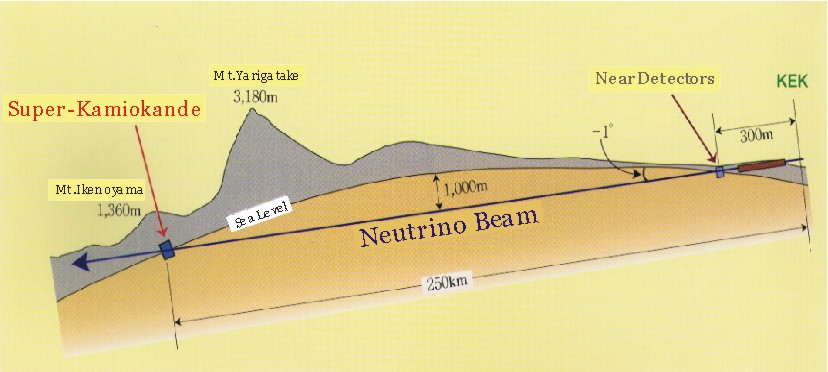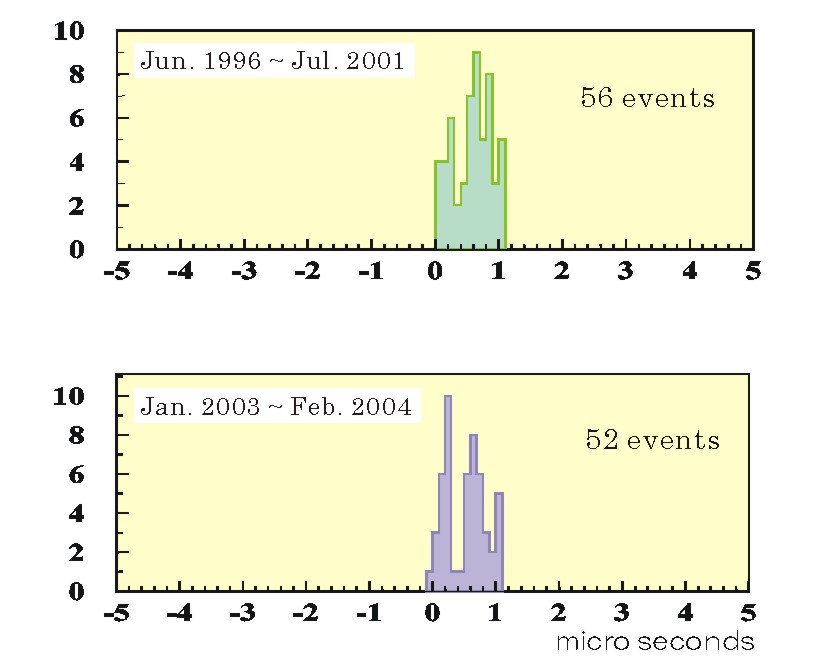






원자구성요소중 하나인 중성미자의 특성을 연구하기 위해 편성된 물리학 국제연구팀 K2K는 KEK의 고에너지 가속기 연구소에서 중성미자 빔을 생성해서 발사한뒤 지하 1km속에 있는 관을 통해 250km 떨어진곳에 중성미자 검출기로 보냈는데, 빔이 퍼지는 정도와 충돌확률을 고려했을때, 이론적으로 151개가 검출될 것으로 예상했으나, 실제 108개가 검출되어 이것은 43개의 중성미자의 진동변환이 일어난것으로 이것은 중성미자가 질량이 있는것을 확실히 입증하는것이라고 밝혔습니다.
neutrino의 경우 그동안 질량이 없는것으로 알려졌고, 가르쳐왔으나, 이번 측정결과 질량이 있다는것으로 밝혀졌습니다. 하지만, 이번에 질량이 있다는것만 확인되었지 질량이 어떻게 된다고 측정은 안되었습니다. 질량이 0에 너무 가까워서 측정하기가 어려운것 같습니다.
PS. 질량이 0인 물질이 무엇일까요?
아래 보도자료 원문을 첨부합니다.
Recent Results From K2K
(KEK to Kamioka Long Baseline Neutrino Oscillation Experiment)
Summary
K2K is an international collaboration of physicists, organized to study the properties of the subatomic particles called neutrinos. A neutrino beam is generated at KEK, the Japanese National High Energy Accelerator Laboratory in Tsukuba, Japan, and directed through the Earth to the Super-Kamiokande underground neutrino detector, located about 250km away. Using data collected through February, 2004, K2K has observed 108 beam-induced neutrino interactions in Super-Kamiokande. In the absence of the phenomenon called neutrino oscillations, which implies that neutrinos have mass, the expected number of such events would be 150.9 (+11.6, -10.0) showing appearant deficit of the observed data. However, the K2K data are consistent with the oscillation effects previously reported by Super-Kamiokande, using data from naturally-produced (atmospheric) neutrinos. K2K also reported the first significant evidence for the energy dependence of the oscillation effect, which is an expected consequence of the oscillation phenomenon. Taking into account measurements of the beam obtained from "near" detectors on the KEK site, the probability that the observed data are consistent with the hypothesis of no oscillations (hence, massless neutrinos) is negligible (10-4).
K2K expects to increase the number of observed events by about 30% during the next year, before the anticipated shutdown of the KEK proton accelerator in 2005. These additional data will include special studies needed to refine plans for the next-generation experiment at the new J-PARC accelerator facility under construction in Tokaimura, Japan.
Details: Goals of the experimentIn 1998, clear evidence for neutrino oscillations was first reported in studies of atmospheric neutrinos by Super-Kamiokande. Neutrino oscillation occurs among the three known “flavors” of neutrinos when neutrinos have non-zero mass and mixing. Under these circumstances, flavor states are mixtures of mass states, and a neutrino may change its apparent flavor with time, for example during the time of flight from KEK to Kamioka. Neutrino masses were assumed to be zero in the current standard model of elementary particle physics. The discovery of neutrino oscillations and hence non-zero neutrino masses requires a theory beyond the standard model, and the apparent smallness of the neutrino masses indicates physics with a large energy scale. The aim of the K2K experiment is to confirm the neutrino oscillation phenomena observed with atmospheric neutrinos, and more precisely determine the neutrino oscillation parameters (mass differences and mixing angles). The experimental method The K2K neutrino beam is produced by the 12 GeV proton accelerator at KEK. These artificially created neutrinos are almost entirely muon-neutrinos, as confirmed by data from the near detectors at KEK, which measure the neutrino flux and energy spectrum immediately after production, and before neutrino oscillation effects become visible. The beam was directed towards the Super-Kamiokande detector located 250km away from KEK. The energy spectrum of the neutrino beam is similar to that of atmospheric neutrinos, and the long baseline of the experiment allows us to test neutrino oscillations effects observed in atmospheric neutrinos. The K2K experiment is the first truly long baseline neutrino oscillation experiment, in which a neutrino beam was directed to a distant off-site detector. Neutrino beam pulses, of duration a few millionths of a second, were sent from KEK to Super-Kamiokande every 2.2 sec. The pulsed time structure of the beam made it possible to distinguish the interactions of beam neutrinos from those of cosmic ray (atmospheric) neutrinos, which arrive randomly in time.
Conclusions Based on these results, we have concluded that
Future K2K will have an additional beam run starting in October, 2004. The ending date may be in March, 2005. While the new data will not significantly increase the overall statistical weight of the experiment, it will be very important for several investigations of detector response and systematics. The KEK 12 GeV proton synchrotron will be shut down in 2005, in order to make equipment and human resources available for construction of the new J-PARC 50 GeV proton accelerator, currently under construction at Tokaimura. One of the main experiments planned for J-PARC is T2K (Tokai to Kamioka), the next-generation long baseline neutrino experiment. The new accelerator will provide an effective factor of 100 increase in event rates, permitting much more detailed investigations of neutrino oscillations and related phenomena. A new Scintillating Bar (SciBar) detector system was installed in the K2K near detector, and commissioned in September, 2003. Scibar was intended in part as an in-service prototype for a critical detector element in the T2K experiment. The 2004-5 K2K run will significantly increase the available SciBar data. We will also perform studies of beam targeting and control, in preparation for T2K. Finally, we will use the next run to complete a variety of background and calibration measurements on the K2K near detectors. K2K and T2K explore fundamental questions in particle physics and astrophysics. However there are still many unresolved issues in these fields, for example the discovery of CP violation, which is closely related to the origin of the asymmetry of matter and anti-matter in the universe. We will continue to challenge those puzzles in near future. |







비씨파크 주식회사, 대표이사 : 박병철 개인정보보호책임자 : 박병철
사업자등록번호 : 114-86-19888 |
본사 : 서울특별시 서초구 서초대로73길, 42, 1307호
전자우편 : master@bcpark.net |
(전화전 이용문의 게시판 필수)
전화: 02-534-982구(09:00~18:00) |
팩스: 02-535-155구 |
긴급: 010-9774-988삼
ㆍ저작권안내 : 비씨파크의 모든 컨텐츠(기사)는 저작권법에 보호를 받습니다. 단, 회원들이 작성한 게시물의 권리는 해당 저작권자에게 있습니다. 비씨파크에 게재된 게시물은 비씨파크의 입장과 다를 수 있습니다. 타인의 저작물을 무단으로 게시, 판매, 대여 또는 상업적 이용시 손해배상의 책임과 처벌을 받을 수 있으며, 이에 대해 책임을 지지 않습니다.
ㆍ쇼핑몰안내 : 비씨파크는 통신판매중개자로서 상품 주문, 배송 및 환불의 의무와 책임은 각 판매 업체에 있습니다.
Copyright ⓒ 2000-2026 BCPARK Inc. All Right Reserved.